

Manufactured Homes
From Trailer Homes to Manufactured Homes
Boulder Ridge is not a trailer park. It is a luxury manufactured home community, and that distinction reflects a century of progress. Early trailer homes gave families the freedom to travel. Today, their descendants offer something different: a thoughtfully designed place where families choose to put down roots. Here is how trailers evolved into mobile homes, mobile homes became manufactured homes, and the industry transformed along the way. Schedule a tour to see what makes us different or call (616) 310-4479.
Why the Names Keep Changing
Trailer home. Mobile home. Manufactured home. Most people use the three names interchangeably, and it is easy to see why. They describe the same lineage of factory-built housing stretched across a hundred years of American life.
The names are not marketing, though. Each one marks a real change in what the home was, how it was built, and what the law required of it. A 1935 trailer, a 1965 mobile home and a home built at Boulder Ridge this year share an ancestor and almost nothing else.
That story is worth knowing, because it explains why the objection people still raise about factory-built housing has been out of date for roughly fifty years.
A Century of Change
From Trailer Parks to Manufactured Home Communities
- 1
Step 1
1920s: The Trailer Is Born to Travel
As cars reached ordinary households, Americans began building sleeping boxes to tow behind them. Small manufacturers turned the hobby into an industry, and the travel trailer arrived: a bed, a stove and a roof, built to follow the road. Nobody was living in one full time. That was the entire point.
- 2
Step 2
1940s: A Bed Near the Factory Gate
The Second World War changed the trailer's job overnight. Defense plants pulled workers into towns that had nowhere to put them, and the federal government bought trailers by the thousand to house those workers and their families near the work. For the first time, large numbers of Americans lived in a trailer as a residence rather than a vacation.
- 3
Step 3
1950s: The Trailer Park Becomes a Neighborhood
The post-war housing shortage kept those families in place. Trailer parks that were meant to be temporary became permanent addresses, with mail delivery, school buses and long-term residents. The reputation those decades produced, fairly or not, is the one the industry has been answering for ever since.
- 4
Step 4
1950s and 1960s: Too Wide to Tow
To make trailers livable year round, builders made them wider. Once units passed roughly ten feet across, they could no longer be towed behind a family car. They were hauled to a site once and stayed there. A home that moves once is not a trailer, so the industry adopted a new name for it: the mobile home.
- 5
Step 5
1976: The Federal Line in the Sand
On June 15, 1976, the federal HUD Code took effect and factory-built housing became the only housing type in America regulated by a single national construction standard. Everything built to that standard is legally a manufactured home. Everything built before it is a mobile home. In 1980 Congress replaced the phrase mobile home with manufactured home throughout federal law.
- 6
Step 6
Today: Built in a Factory, Built to Stay
There are several benefits to today's manufactured houses. Multi-section homes, drywall interiors, cathedral ceilings, full-size appliances and energy-efficient construction turned the category into genuine housing rather than a compromise. A modern manufactured home is delivered to its site, set on a permanent foundation and never moves again.
The Trailer Park Era
What the Trailer Park Actually Was
It is worth being honest about this chapter rather than skipping it. Mid-century trailer parks were built for units that were never designed to be lived in permanently, and it showed. Homes were small, thin-walled and cheaply made. Lots were tight. Because no construction standard governed them, quality depended entirely on who built the unit and how carefully.
Those parks solved a real problem. They housed working families during a national housing shortage, at a price ordinary people could pay, without waiting years for a house to be framed. They were also the beginning of something that would take decades to grow up.
The word people still reach for comes from this era. The homes and the communities both moved on. The vocabulary is simply lagging behind.
The Mobile Home
When the Trailer Stopped Moving
The mobile home era is the hinge of the whole story, and it turns on a practical detail: width. Families wanted more room, builders delivered it, and the resulting homes were too wide to hitch to a car. They were transported to a lot once, by a professional hauler, and set in place.
That single change pulled everything else along with it. Homes designed to stay put could have real insulation, real plumbing, real appliances and layouts that made sense for daily living rather than a weekend. By the 1960s the industry had split cleanly in two: travel trailers for recreation, and mobile homes as housing.
What the era did not have was a construction standard. Quality varied enormously from builder to builder, and there was no baseline a buyer could count on. That gap is exactly what the federal government stepped in to close.

The HUD Code
June 15, 1976: Mobile Home Becomes Manufactured Home
The federal HUD Code took effect on June 15, 1976, and set nationwide, enforceable requirements for how factory-built homes are designed, constructed, wired, plumbed and insulated, including standards for fire safety, wind resistance and energy efficiency. Because it is a federal standard, it applies identically in every state, and inspection happens in the factory while the home is being built rather than after the fact. Wind standards were strengthened again in 1994 following Hurricane Andrew.
So the distinction between a mobile home and a manufactured home is not a euphemism. It is a date and a body of federal law. A home built before June 15, 1976 is a mobile home. A home built after it is a manufactured home, and it was inspected to a standard no site-built house in America is measured against nationally.
One federal construction standard, enforced identically in all fifty states
Structural, fire safety, wind resistance, plumbing, electrical and energy requirements
Inspected in the factory, at every stage, before the home ever reaches its lot
Legally renamed from mobile home to manufactured home in federal law in 1980
This is the reason a modern manufactured home is not comparable to what someone remembers from decades ago. They are not the same product, and they have not been for nearly fifty years.
The Community
The Homes Grew Up. So Did the Neighborhoods.
The homes are only half the story. A community built for units that were parked temporarily looks nothing like a community built for homes that are here permanently, and that evolution ran alongside the construction changes.
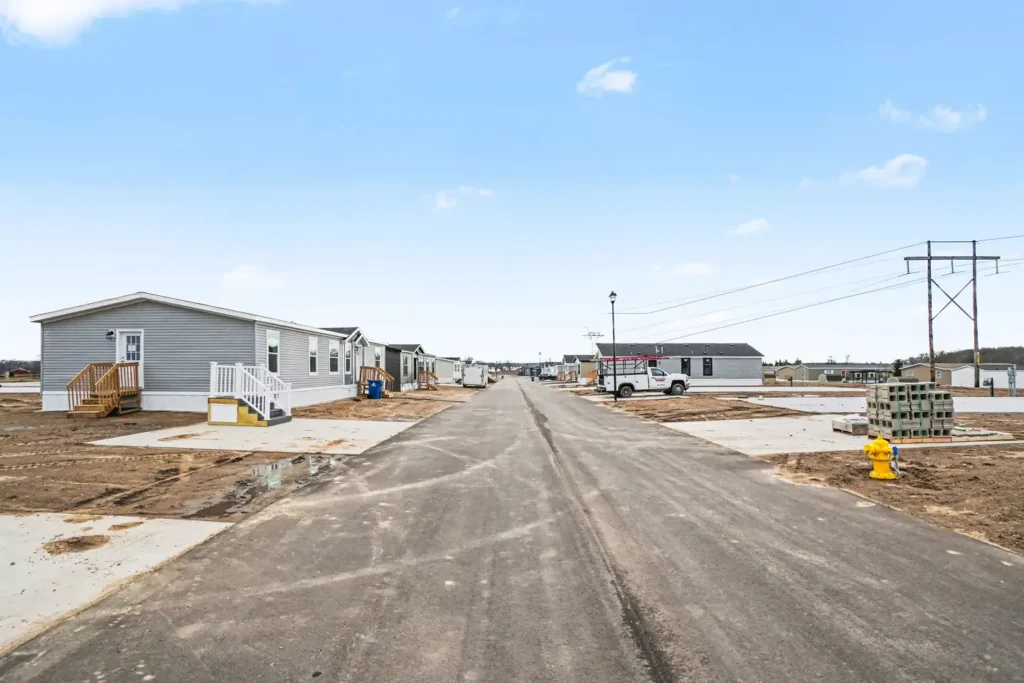
When Boulder Ridge opened, it was planned from the ground up as a residential neighborhood. Paved streets and full-size lots. A clubhouse, heated swimming pool, fitness center, game room, library and playground. Maintained landscaping and green space. Community standards that keep the place looking the way it looked the day you toured it.
Residents own their homes and lease the land beneath them, which is what keeps the price reachable while the amenities stay shared. It is the same arrangement the trailer park used, applied to a very different kind of home and a very different kind of neighborhood.
That is where a hundred years of evolution lands: new homes and pre-owned homes are built to a federal standard, set permanently on a full-size lot, in a community with a pool and a clubhouse, starting from $185,000.
Common Questions About the History
Still have questions? Call us at (616) 310-4479, read through more frequently asked questions, or learn more about us.
Ready to See It for Yourself?
You have seen how factory-built housing evolved. Now see what modern manufactured home living looks like at Boulder Ridge. Tour our available homes, explore the community, and let our team help you find the right fit for your lifestyle and budget. We welcome homebuyers from Allendale, Grand Rapids, Grand Haven, Holland, Muskegon, and throughout West Michigan. Schedule your personal tour or call (616) 310-4479 to experience Boulder Ridge for yourself.
